-
19 days
-
Everest
-
Strenuous
-
6,189 m
-
From 1 person
-
Peak climbing
Highlights
- Summit of Island Peak (6,189 m), a classic first Himalayan climb
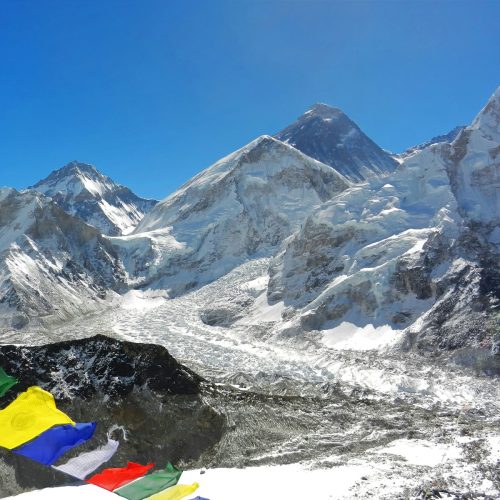
- Everest Base Camp and sunrise from Kala Patthar (5,545 m) on the way
- Close views of Lhotse, Makalu, Ama Dablam and Baruntse from the summit
- Training with crampons, ice axe and fixed ropes before summit day
- Namche Bazaar, Tengboche Monastery and the Chhukung valley
- A reserve day in case of bad weather on summit day
Overview
Island Peak (6,189 m), also known as Imja Tse, rises from the Chhukung valley below the south face of Lhotse. It was named by members of the 1953 British Everest expedition, because from Dingboche it looks like an island in a sea of ice, and it is one of the most popular first Himalayan summits.
The trip follows the classic trail to Everest Base Camp and Kala Patthar (5,545 m), which gives you time to acclimatize. From Dingboche you move up the Imja valley via Chhukung to Island Peak Base Camp (5,240 m) for training, and summit day takes you over rock and glacier to a fixed-rope headwall and a narrow summit ridge with close views of Lhotse, Makalu, Ama Dablam and Baruntse.
If you have less time and do not need to see Everest Base Camp, our 15-day Island Peak Climbing goes straight to Chhukung and the climb.
Know before you go
Best time to go
The climbing seasons are spring (April to May) and autumn (late September to November). Autumn usually has the most stable weather and the clearest views, while spring is slightly warmer on summit day.
Winter brings severe cold and strong winds high on the mountain, and during the monsoon the views are poor and snow conditions unreliable. We only run climbs in the main seasons.
Difficulty and fitness
Island Peak is a strenuous climb but a good first Himalayan summit. Summit day is long: ten to twelve hours from base camp, with a steep rocky section, a glacier crossing and a fixed-rope climb up a snow and ice headwall to the summit ridge.
You should be in very good physical condition and comfortable with long days at altitude. Previous experience with crampons is helpful but not required.
Preparation and equipment
Before summit day our climbing guide runs a training session on using crampons, ice axe, harness, ascender and fixed ropes.
You need warm layers, a down jacket, mountaineering boots and personal climbing gear (harness, crampons, ascender and helmet), which can be rented in Kathmandu. We check your equipment with you before departure. Cardio training, long hill walks and strength exercises in the two to three months before the trip are strongly recommended.
Permits
You need a Sagarmatha National Park entry permit, the Khumbu Pasang Lhamu Rural Municipality permit and an Island Peak climbing permit.
We arrange all permits for you before the trip. See Includes/Excludes for what is covered in the price.
Itinerary
Welcome to Nepal. On arrival at Tribhuvan International Airport, a Pikey Sherpa Adventure representative will meet you and transfer you to your hotel. Your climbing guide checks your gear, helps arrange any rental equipment and completes the climbing permit, followed by a briefing on the climb. Overnight in a hotel in Kathmandu (1,400 m).
An early-morning mountain flight takes you to Lukla, with views of the Himalaya on the way in. After meeting the porters, you set off on a gentle three-to-four-hour walk down through Sherpa villages and along the Dudh Koshi river. Please note: in the main seasons (March–May and October–November), Lukla flights usually depart from Manthali airport in Ramechhap, about a 4–5 hour drive from Kathmandu, so the day starts very early. Overnight in a teahouse in Phakding (2,610 m).
Today the trail follows the Dudh Koshi, crossing several suspension bridges before a long, steady climb to Namche Bazaar, the main trading town of the Khumbu. Take the ascent slowly and drink plenty of water; the walk usually takes six to seven hours. Overnight in a teahouse in Namche Bazaar (3,440 m).
A rest day in Namche is essential for acclimatization, following the rule of climbing high and sleeping low. A morning hike leads up to the Everest View Hotel for views of Everest and Ama Dablam, then on to the Sherpa village of Khumjung before you return to Namche. Overnight in a teahouse in Namche Bazaar (3,440 m).
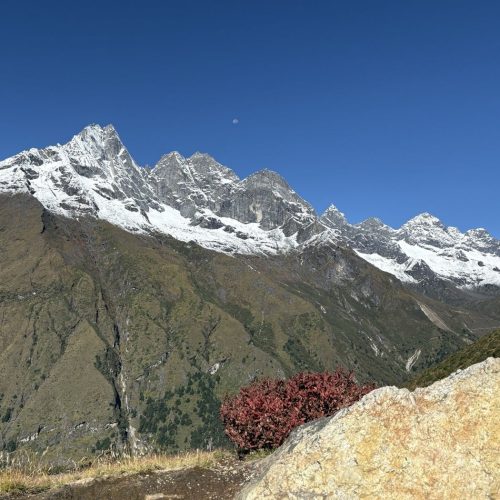
A scenic trail contours high above the Dudh Koshi with views of Ama Dablam, Everest and Lhotse, before dropping to the river and climbing to Tengboche. The village is home to the famous Tengboche monastery, and the evening light on the peaks is memorable. Overnight in a teahouse in Tengboche (3,860 m).
The trail descends through rhododendron forest, crosses the Imja Khola and climbs gradually past mani walls and small settlements into open alpine country. Dingboche sits in a wide valley of stone-walled fields beneath Ama Dablam and Island Peak. Overnight in a teahouse in Dingboche (4,410 m).
A second acclimatization day helps your body adjust before the higher ground ahead. A hike up the Nangkartshang ridge above the village offers wide views of Makalu, Lhotse and Ama Dablam, after which you return to Dingboche to rest. Overnight in a teahouse in Dingboche (4,410 m).
The trail climbs gradually across open terrain and then beside the Khumbu Glacier towards Lobuche, with Pumori and Nuptse rising ahead. Walk at a steady pace and keep drinking; the air is noticeably thinner now. Overnight in a teahouse in Lobuche (4,910 m).
A short walk along the Khumbu Glacier moraine brings you to Gorak Shep, where you drop your bags and have lunch. In the afternoon you continue to Everest Base Camp, with close views of the Khumbu Icefall, before returning to Gorak Shep. Overnight in a teahouse in Gorak Shep (5,164 m).
An early start takes you up Kala Patthar (5,545 m) for sunrise over Everest and the surrounding peaks. After breakfast in Gorak Shep you make the long descent back down the valley, which also helps you recover before the climb. Overnight in a teahouse in Dingboche (4,410 m).
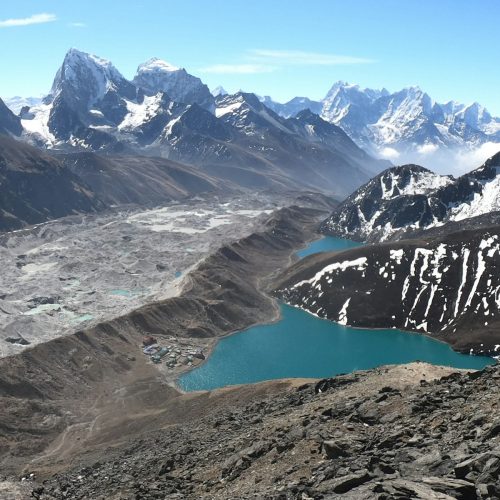
A short walk up the Imja valley past stone-walled yak pastures brings you to Chhukung, surrounded by Lhotse, Island Peak and Ama Dablam. The short day lets you rest and acclimatize before the climb. Overnight in a teahouse in Chhukung (4,730 m).
The trail follows the moraine of the Lhotse Glacier to Island Peak Base Camp at Pareshaya Gyab. In the afternoon your climbing guide runs a training session on fixed ropes, ascenders, crampons and abseiling to prepare you for the summit. Overnight in a tented camp at Island Peak Base Camp (5,240 m).
You leave camp in the pre-dawn hours with headlamps, climbing rocky slopes to the glacier, where you rope up and use crampons and fixed ropes on the final headwall to the summit (6,189 m). After taking in the views, you descend carefully to base camp and on to Chhukung, a long day of ten to twelve hours. Overnight in a teahouse in Chhukung (4,730 m).
A spare day in case bad weather or snow conditions delay the summit. If it is not needed, you begin the descent and have an easier walk over the following days. Overnight in a teahouse in Chhukung (4,730 m) or lower down the valley.
A long descent takes you back down the Imja valley past Dingboche and Pangboche, with the thicker air making the walking easier. The day ends at Tengboche and its famous monastery. Overnight in a teahouse in Tengboche (3,860 m).
The trail drops to the Dudh Koshi and climbs back up to the balcony trail, with views of Ama Dablam and Everest, before the final stretch to Namche Bazaar. Overnight in a teahouse in Namche Bazaar (3,440 m).
On the final trekking day you retrace your steps down the Dudh Koshi valley, crossing suspension bridges before a last climb up to Lukla. It is a good evening to thank your guide and porters and enjoy a relaxed dinner together. Overnight in a teahouse in Lukla (2,860 m).
An early-morning flight takes you back from Lukla to Kathmandu, with a final look at the mountains from the air. On arrival you are transferred to your hotel, and the rest of the day is free to relax, explore or celebrate with your team. Overnight in a hotel in Kathmandu (1,400 m).
Your trip ends today. Depending on your flight time, you may have a few free hours for last-minute shopping or a final stroll, before a Pikey Sherpa Adventure representative transfers you to Tribhuvan International Airport for your onward flight.